
Vitreous: 3D Point Cloud Processing Skills
SUMMARY
Vitreous is a module in the Telekinesis SDK containing skills for 3D point cloud processing.
It provides a comprehensive set of skills for 6D pose estimation, 3D object detection, point cloud filtering, segmentation, and clustering. Vitreous is designed for building applications such as vision-based pick-and-place, bin picking, and robot navigation, where reliable 3D perception is critical.
When to Use Vitreous?
Use Vitreous when your application relies on 3D perception with point clouds, such as:
- Vision-based pick and place
- Bin picking and object localization
- Robot navigation and environment understanding
- Scene reconstruction and spatial reasoning
What does Vitreous Provide?
Vitreous includes a collection of modular skills for:
- 6D pose estimation
- 3D object detection
- Point cloud filtering and downsampling
- Segmentation and clustering
- Geometric feature extraction
How to Use Vitreous?
To use the skills from Vitreous, simply use:
from telekinesis import vitreousHere is a minimal example:
from telekinesis import vitreous, datatypes

# ===================== Load Data==========================================
point_cloud_url = "https://assets.telekinesis.ai/examples/v1point_clouds/can_vertical_1_subtracted.ply"
point_cloud = datatypes.PointCloud.from_ur(url=point_cloud_url, use_cache=True)

# ===================== Run Skill ==========================================
filtered_point_cloud = vitreous.filter_point_cloud_using_voxel_downsampling(
    voxel_size=0.005, point_cloud=point_cloud
Overview of Skills
Calculate Axis Aligned Bounding Box
Learn how to compute the smallest 3D axis-aligned bounding box (AABB) for a point cloud using the Telekinesis Agentic Skill Library. Ideal for Physical AI, robotics, computer vision, and scene understanding pipelines.
Calculate Oriented Bounding Box
Learn how to compute a tightly-fitted, orientation-aware 3D bounding box (OBB) for a point cloud using the Telekinesis Agentic Skill Library. Ideal for Physical AI, robotics, computer vision, pose estimation, and grasp planning.
Calculate Plane Normal
Learn how to compute the normal vector of a plane from its coefficients using the Telekinesis Agentic Skill Library. Ideal for Physical AI, robotics, computer vision, surface alignment, and plane-based reasoning.
Calculate Point Cloud Centroid
Learn how to compute the geometric center (centroid) of a 3D point cloud using Telekinesis Vitreous. Useful for robotics, Physical AI, object localization, grasp planning, and reference frame computation.
Cluster Point Cloud Based on Density Jump
Segment a point cloud into clusters by detecting sharp density changes along a chosen axis using Telekinesis Agentic Skill Library. Ideal for stacked objects, layered structures, or closely packed items in robotics and Physical AI pipelines.
Cluster Point Cloud Using DBSCAN
Segment a 3D point cloud into clusters using DBSCAN from the Telekinesis Agentic Skill Library. Ideal for detecting distinct objects, handling noise, and separating spatially distributed items in robotics and perception pipelines.
vitreous.convert_depth_image_to_point_cloud()VitreousConvert Depth Image to Point Cloud
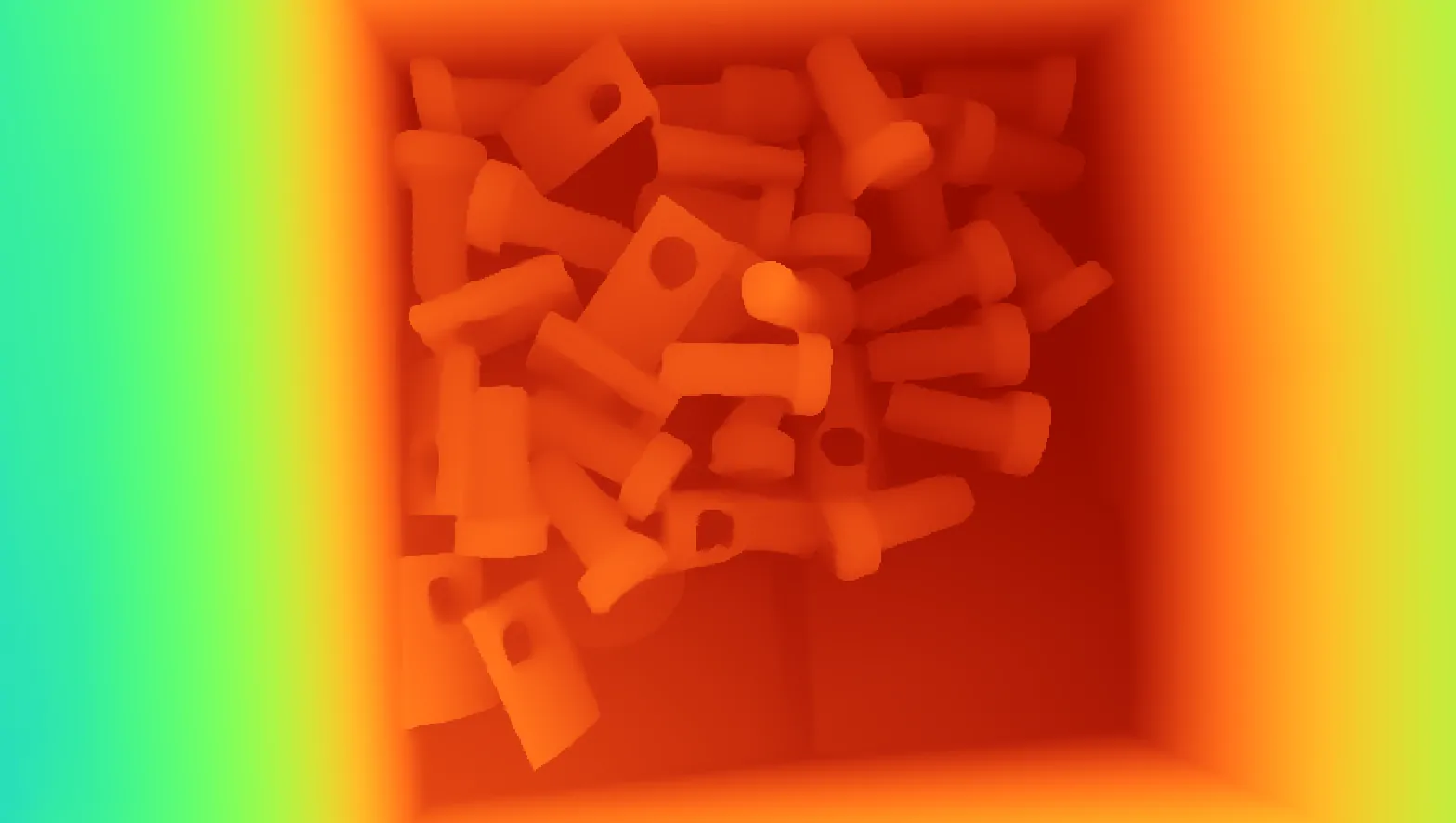
Back-project a depth image into a 3D point cloud using a pinhole camera model and camera intrinsics, with the Telekinesis SDK. Ideal for turning RGB-D/depth sensor output into point clouds for robotics perception pipelines.
vitreous.convert_mesh_to_point_cloud()VitreousConvert Mesh to Point Cloud
Convert 3D triangle meshes into point clouds using the Telekinesis SDK. Ideal for 6D pose estimation, registration, and robotic perception pipelines with controlled point sampling density.
vitreous.convert_depth_image_to_point_cloud()VitreousConvert Depth Image to Point Cloud
Back-project a depth image into a 3D point cloud using a pinhole camera model and camera intrinsics, with the Telekinesis SDK. Ideal for turning RGB-D/depth sensor output into point clouds for robotics perception pipelines.
Create Cylinder Mesh
Generate a 3D cylinder mesh using the Telekinesis SDK for pose estimation, 3D detection, and robotics perception pipelines. Ideal for representing rods, pipes, and cylindrical objects with precise geometry.
Create Plane Mesh
Generate a 3D plane or cuboid mesh using the Telekinesis SDK for pose estimation, 3D detection, and robotics perception pipelines. Ideal for representing floors, walls, tabletops, or planar reference surfaces.
Create Sphere Mesh
Generate a 3D spherical mesh using the Telekinesis SDK for pose estimation, 3D detection, and robotics perception pipelines. Ideal for representing balls, spherical markers, or rounded components with precise geometry.
Create Torus Mesh
Generate a 3D torus mesh using the Telekinesis SDK for pose estimation, 3D detection, and robotics perception pipelines. Ideal for representing rings, wheels, or circular components with parametric precision.
 Vitreous
Estimate Depth Using Fast-FoundationStereo
Estimate a metric depth map from a rectified stereo image pair using NVIDIA's Fast-FoundationStereo, a real-time zero-shot stereo-matching model, with the Telekinesis SDK. No per-scene calibration or fine-tuning required.
vitreous.estimate_pose_using_foundation_pose()VitreousEstimate Pose Using FoundationPose
Estimate and track a 6-DOF object pose from an RGB-D frame and a CAD mesh using NVIDIA's FoundationPose, a zero-shot pose estimation and tracking model, with the Telekinesis SDK. No per-object training required.
Estimate Principal Axis Within Radius
Compute the dominant local direction of a 3D point cloud neighborhood using PCA for grasp planning, fine manipulation, and local feature analysis in industrial robotics.
Estimate Principal Axes
Compute the principal directions of a 3D point cloud using PCA or OBB for industrial robotic manipulation, grasp planning, and object orientation estimation.
Filter Point Cloud Using Pass Through Filter
Retain points within specified axis-aligned bounds using a passthrough filter for robotics tasks like workspace region extraction, object isolation, and perception.
Filter Point Cloud Using Bounding Box
Extract points within a 3D axis-aligned bounding box (AABB) to isolate regions of interest in point clouds for robotics, grasp planning, and object detection.
Filter Mesh Using Cylinder Base Removal
Remove base points from cylindrical meshes to isolate object geometry for robotics applications like pose estimation, grasp planning, and cylinder alignment.
Filter Point Cloud Using Mask
Apply a 2D boolean mask to selectively filter points from an organized point cloud for robotics tasks like object segmentation, ROI extraction, and grasp planning.
Filter Point Cloud Using Oriented Bounding Box
Crop a point cloud to a rotated 3D region using an oriented bounding box (OBB) for robotics tasks like object isolation, pose estimation, and manipulation.
Filter Point Cloud Using Plane Defined by Point Normal Proximity
Extract points near a plane defined by a reference point and normal vector for robotics tasks like planar surface extraction, ground removal, and tabletop detection.
Filter Point Cloud Using Plane Proximity
Extract points near a plane defined by coefficients [a, b, c, d] for robotics tasks like planar surface extraction, ground removal, and tabletop detection.
Filter Point Cloud Using Plane Splitting
Retain points on one side of a plane using coefficients [a, b, c, d]. Ideal for robotics tasks like ground removal, workspace segmentation, and object separation.
Filter Point Cloud Using Radius Outlier Removal
Remove isolated or noisy points in a point cloud using radius-based neighbor filtering. Ideal for denoising, preprocessing, and improving 3D perception in robotics.
Filter Point Cloud Using Statistical Outlier Removal
Remove noise from point clouds using statistical analysis of neighbor distances. Ideal for denoising, preprocessing, and improving 3D perception in robotics pipelines.
Filter Point Cloud Using Uniform Downsampling
Reduce point cloud density by selecting every Nth point for faster processing. Ideal for robotics pipelines, preview generation, and preprocessing of large 3D datasets.
 Vitreous
Filter Point Cloud Using Viewpoint Visibility
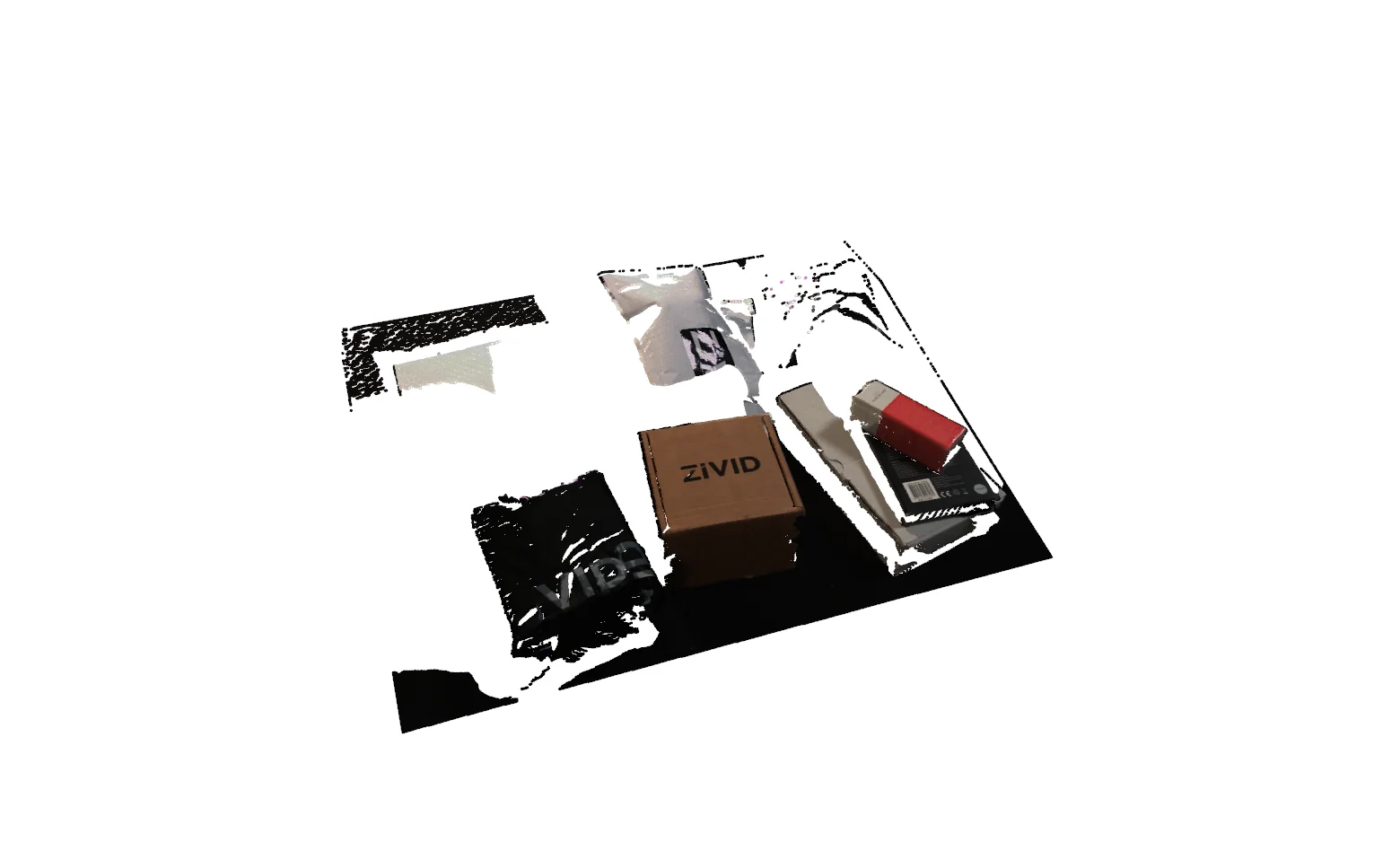
Remove occluded points from a point cloud based on a specific viewpoint. Ideal for robotics pipelines, sensor simulation, and occlusion-aware perception.
Filter Point Cloud Using Voxel Downsampling
Reduce point cloud density using voxel downsampling. Ideal for preprocessing, registration, clustering, and segmentation in robotics and 3D point cloud workflows.
 Vitreous
Generate Grasps Using Antipodal Sampler
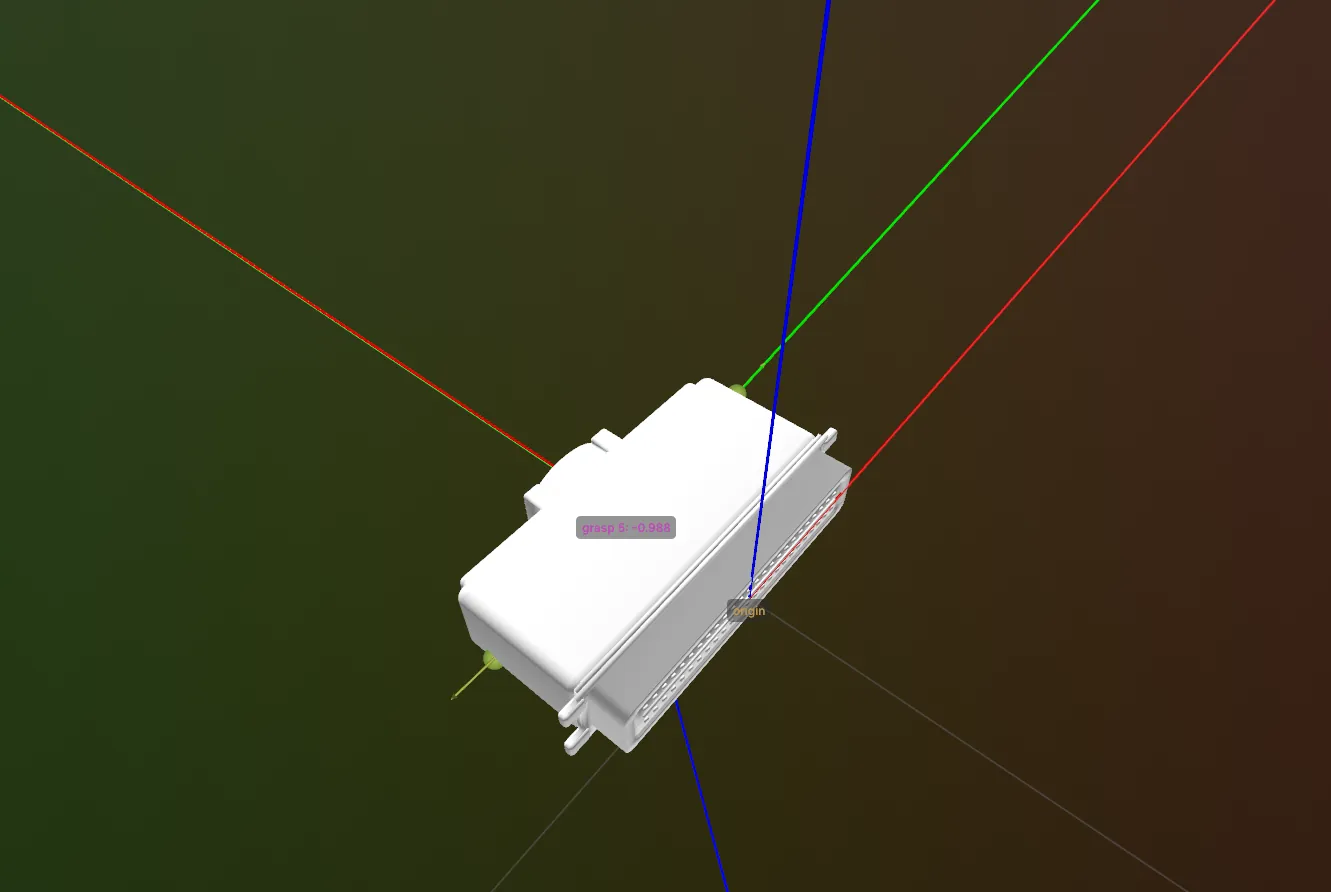
Generate reproducible parallel-jaw grasp poses from opposing surface contacts on an object mesh for robotic grasp planning.
Add Point Clouds
Learn how to combine two 3D point clouds into a single unified cloud using the Telekinesis Agentic Skill Library. Perfect for multi-view fusion, sensor aggregation, and robotics pipelines.
Subtract Point Clouds
Learn how to subtract one point cloud from another using the Vitreous SDK. Ideal for isolating objects, removing backgrounds, or filtering known surfaces in robotics, industrial pipelines, and 3D perception.
Scale Point Cloud
Learn how to uniformly scale a point cloud about a center point using the Vitreous SDK. Ideal for resizing objects and scenes in robotics, industrial pipelines, and simulations.
Apply Transform to Point Cloud
Learn how to move, rotate, or align 3D point clouds using the Telekinesis Agentic Skill Library. Ideal for Physical AI, robotics, computer vision, and multi-view sensor pipelines.
Project Point Cloud to Plane
Learn how to project a 3D point cloud onto a plane using general plane coefficients [a, b, c, d] with the Vitreous SDK. Useful for robotics, AI, and physical pipelines in planar alignment, ground plane removal, and feature extraction.
Project Point Cloud to Plane Defined by Point Normal
Learn how to project a 3D point cloud onto a plane using a reference point and normal vector with the Vitreous SDK. Useful for robotics, AI, and physical pipelines in planar alignment, registration, and feature extraction.
Reconstruct Mesh Using Convex Hull
Learn how to reconstruct a convex mesh from a 3D point cloud using the Vitreous SDK. Ideal for robotics, AI, and physical pipelines in collision geometry, grasp planning, and simplified object modeling.
Reconstruct Mesh Using Poisson
Learn how to reconstruct a smooth, watertight 3D mesh from a point cloud with normals using Poisson surface reconstruction with the Vitreous SDK. Ideal for high-quality object surfaces in robotics, AI, and industrial pipelines.
vitreous.register_point_clouds_using_centroid_translation()VitreousRegister Point Clouds Using Centroid Translation
Compute a fast, coarse translation-only alignment between two point clouds by matching their centroids, using the Telekinesis SDK. Ideal as a first step before finer ICP-based registration.
Register Point Clouds Using Cuboid Translation Sampler ICP
Align two point clouds with an uncertain relative translation by sampling candidate translations on a 3D grid and refining each with ICP, keeping the best-scoring result.
Register Point Clouds Using Fast Global Registration
Align two point clouds using Fast Global Registration (FGR), a feature-based method that matches points by FPFH descriptor similarity and does not require the clouds to already be roughly aligned.
Register Point Clouds Using Point to Plane ICP
Refine the alignment of two roughly pre-aligned point clouds by minimizing each source point's distance to the target surface's tangent plane, using surface normals for faster, more accurate convergence.
Register Point Clouds Using Point to Point ICP
Refine the alignment of two roughly pre-aligned point clouds with the classic Iterative Closest Point (ICP) algorithm, minimizing raw point-to-point distances.
Register Point Clouds Using Rotation Sampler ICP
Align two point clouds with an uncertain relative rotation by sampling candidate rotations on a grid of Euler angles and refining each with ICP, keeping the best-scoring result.
Segment Point Cloud Using Color
Learn how to segment point clouds by color using the Vitreous SDK. Ideal for identifying and isolating objects based on color cues in robotics, industrial pipelines, and 3D perception.
Segment Point Cloud Using Plane
Learn how to segment planar surfaces from point clouds using the Vitreous SDK. Ideal for detecting floors, walls, tables, and other flat surfaces in robotics, industrial pipelines, and 3D perception.
vitreous.segment_point_cloud_using_vector_proximity()VitreousSegment Point Cloud Using Vector Proximity
Keep or remove points near an infinite 3D line defined by a point and direction vector, using the Telekinesis SDK. Ideal for isolating rods, cables, edges, or other linear structures in a point cloud.