

Segment Image Using Felzenszwalb
SUMMARY
Segment Image Using Felzenszwalb segments an image into superpixels using Felzenszwalb's graph-based method.
The algorithm builds a graph over the image's pixels, with edges weighted by color/intensity difference, then greedily merges regions whose internal variation is small relative to the difference between them. This produces irregularly-shaped superpixels that tend to follow object boundaries, rather than the uniform grid-like superpixels produced by segment_image_using_slic_superpixel.
Use this Skill when you want to create superpixels that adapt to image content and follow object boundaries.
The Skill
from telekinesis import cornea

segmented_image = cornea.segment_image_using_felzenszwalb(
    image=image,
    scale=500,
    sigma=1,
    min_size=200,
)Example
Input Image
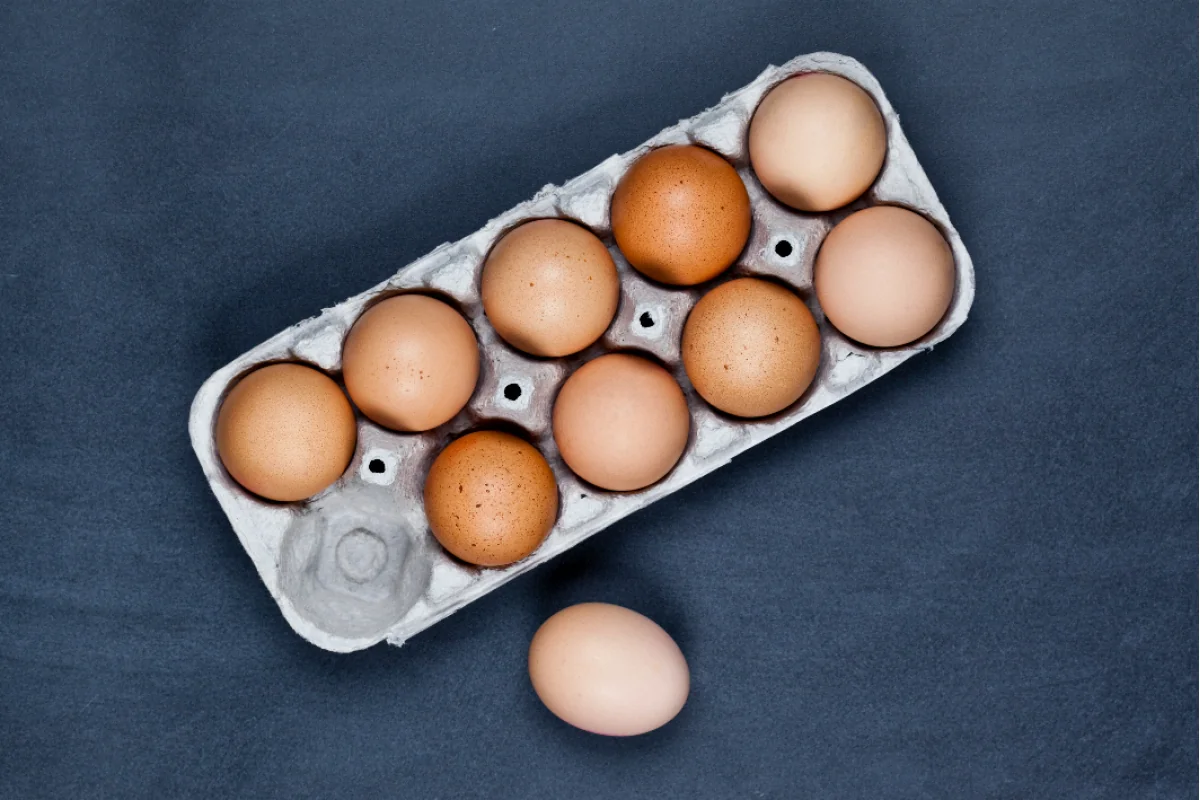
Original image for Felzenszwalb segmentation
Output Image
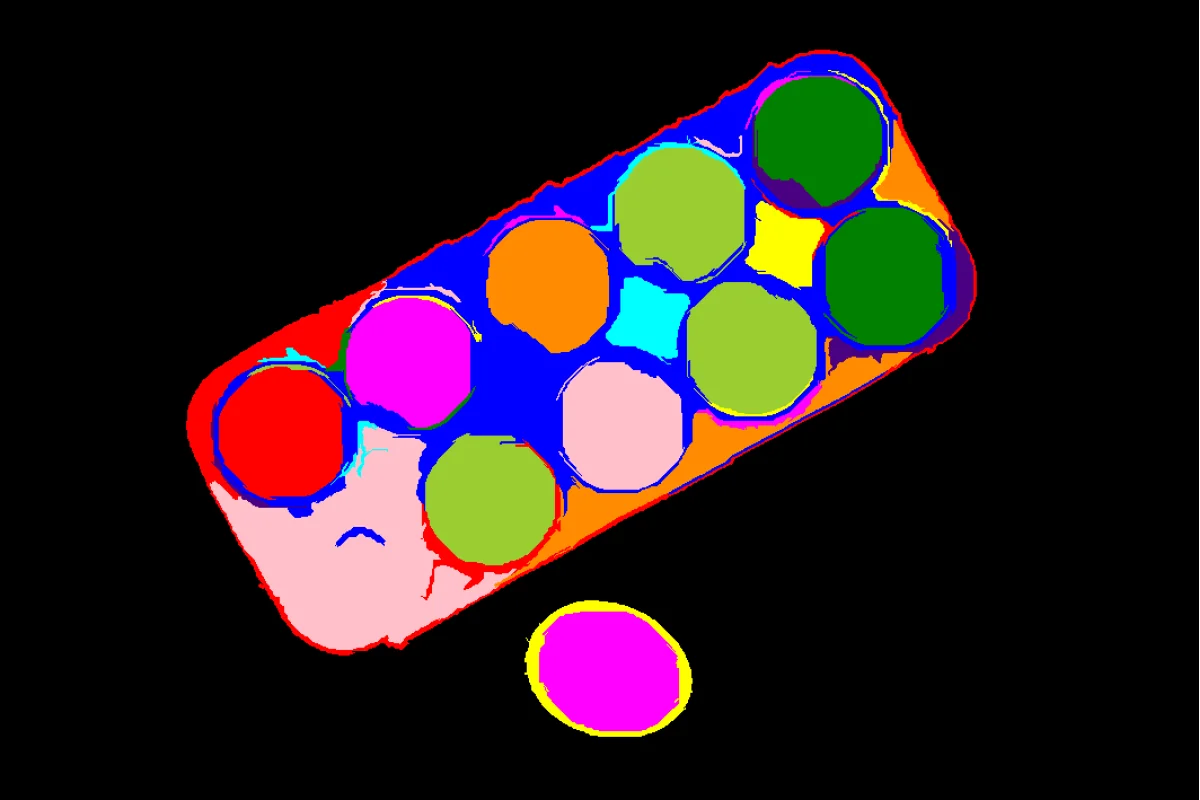
Superpixel segmentation using the Felzenszwalb algorithm
The Code
"""
Demonstrates Felzenszwalb segmentation.
"""

from loguru import logger
import rerun as rr
import rerun.blueprint as rrb

from telekinesis import cornea, datatypes

def segment_image_using_felzenszwalb_example():
    """Segments an image using the Felzenszwalb algorithm."""
    # ===================== Load Image ==========================================
    image_url = "https://assets.telekinesis.ai/examples/v1/images/eggs_carton.jpg"
    image = datatypes.Image.from_url(url=image_url)

    # ===================== Run Skill ==========================================
    segmented_image = cornea.segment_image_using_felzenszwalb(
        image=image, scale=500, sigma=1, min_size=200
    )

    # ===================== Log ================================================
    logger.success(f"Segmented {image} using the Felzenszwalb algorithm.")
    logger.success(f"Results: {segmented_image}")
    logger.info(f"Segmented image label codes: {segmented_image.label_codes}")
    logger.info(f"Segmented image number of labels: {segmented_image.number_of_labels}")
    logger.info(f"Segmented image shape: {segmented_image.shape}")
    logger.info(f"Segmented image dtype: {segmented_image.dtype}")

    # ===================== Visualization  (Optional) ======================
    rr.init("segment_image_using_felzenszwalb_example", spawn=True)
    blueprint = rrb.Horizontal(
        rrb.Spatial2DView(origin="/input_image", name="Input"),
        rrb.Spatial2DView(origin="/segmented_image", name="Output"),
    )
    rr.send_blueprint(blueprint)
    datatypes.visualize(image, entity_path="/input_image")
    datatypes.visualize(segmented_image, entity_path="/segmented_image")


if __name__ == "__main__":
    segment_image_using_felzenszwalb_example()
Runnable examples are available in the Telekinesis examples repository.
Follow the README in that repository to set up the environment, run this specific example with:
cd telekinesis-examples
python examples/segmentation/segment_image_using_felzenszwalb.py
Parameter Configuration
| Parameter | Type | Default | Description |
|---|---|---|---|
image | datatypes.Image | np.ndarray | required | Input image to segment, shape (H, W, 3) |
scale | datatypes.Int | int | 100 | Sets the scale of observation. Higher values favor larger segments (a higher bar for merging regions); lower values produce more, smaller segments. Dimensionless — tune relative to your image |
sigma | datatypes.Float | float | 0.5 | Standard deviation of the Gaussian smoothing applied before segmentation. 0 disables smoothing entirely |
min_size | datatypes.Int | int | 50 | Minimum segment size, in pixels, enforced as a post-processing step. Segments smaller than this are merged into a neighbor |
Returns
| Type | Description |
|---|---|
datatypes.SegmentationImage | A per-pixel label map, shape (H, W), where each pixel's value identifies which superpixel it belongs to. Use .data for the raw label array, .label_codes for the sorted array of unique superpixel ids, .number_of_labels for how many superpixels were found, and .shape/.dtype for its size and label dtype. |
Raises
| Exception | Condition |
|---|---|
TypeError | A parameter's value does not match its expected type (see the Parameter Configuration table above) |
ConfigurationError | The TELEKINESIS_API_KEY environment variable is not set |
SerializationError | The request input failed to serialize, the response was not returned as an Arrow stream, or the response failed to deserialize |
RequestTimeoutError | The request to the Cornea service timed out |
TransportError | A network failure occurred before a response was received |
ClientError | The Cornea service rejected the request due to invalid or malformed input (HTTP 400/422), an unrecognized endpoint (HTTP 404), or another unexpected 4xx response |
AuthenticationError | The API key was rejected as invalid or expired (HTTP 401) |
AuthenticationServiceError | The authentication service returned an invalid response, was temporarily unavailable, or timed out (HTTP 502/503/504) |
ServerError | The Cornea service returned a 5xx or otherwise unexpected error response |
How to Tune the Parameters
The segment_image_using_felzenszwalb Skill exposes three parameters that together control how many superpixels are produced and how closely they follow object boundaries.
scale
- Controls: The bar for merging two regions during the graph-based clustering — effectively the scale of observation.
- Default:
100 - Increase → favors larger segments (fewer, coarser superpixels)
- Decrease → produces more, smaller segments
- Typical range: 50–500
sigma
- Controls: The standard deviation of the Gaussian smoothing applied to the image before segmentation.
- Default:
0.5 - Increase → smooths out more noise/fine texture before segmenting, yielding fewer, coarser segments
- Decrease → (or
0) disables smoothing, keeping the algorithm sensitive to fine detail - Typical range: 0.1–2.0
min_size
- Controls: The minimum segment size, in pixels, enforced as a post-processing step after the graph merge.
- Default:
50 - Increase → merges more small fragments into a neighboring segment, eliminating noise
- Decrease → preserves small segments
- Typical range: 20–200
TIP
Recommended tuning order: Start with the defaults and adjust scale first to land on roughly the right number of superpixels. Use sigma to control sensitivity to noise/texture, then raise min_size if small, spurious fragments remain.
Where to Use the Skill
Common pipelines include:
- Superpixel generation – Over-segmenting an image into boundary-following regions as a first step before further processing
- Object proposal generation – Producing irregular candidate regions that respect natural object boundaries
- Preprocessing for filtering – Pairing with
filter_segments_by_area,filter_segments_by_color, orfilter_segments_by_maskto keep only the superpixels relevant to a downstream task - Image simplification – Reducing an image to a small number of content-adaptive regions before analysis
Alternative Skills
| Skill | vs. Segment Image Using Felzenszwalb |
|---|---|
| segment_image_using_slic_superpixel | Produces uniform, grid-like superpixels instead of irregular, boundary-following ones. Use SLIC when you want a predictable superpixel count/size; use Felzenszwalb when you want superpixels that adapt to image content. |
| filter_segments_by_area | Not an alternative — a natural next step. Drops superpixels whose pixel area falls outside a chosen range. |
| filter_segments_by_color | Not an alternative — a natural next step. Drops superpixels whose mean intensity falls outside a chosen range. |
| filter_segments_by_mask | Not an alternative — a natural next step. Keeps only the superpixels that overlap a region-of-interest mask. |
When Not to Use the Skill
Do not use Segment Image Using Felzenszwalb when:
- You need a predictable, uniform superpixel count or size — the number and shape of segments depend on
scaleand local image content, not a direct count you set. Usesegment_image_using_slic_superpixelinstead. - You need regular, grid-like superpixel shapes — Felzenszwalb superpixels are irregular by design, following object boundaries rather than a spatial grid.
TIP
Because superpixel count and shape both come from scale, sigma, and image content rather than a direct target, treat the output as over-segmentation to refine — pair it with filter_segments_by_area, filter_segments_by_color, or filter_segments_by_mask to keep only the superpixels relevant to your task.