

Generate Grasps Using Antipodal Sampler
SUMMARY
Generate Grasps Using Antipodal Sampler samples pairs of opposing contacts on a triangle mesh, filters them by surface-normal alignment and gripper opening, and returns world-frame grasp poses with scores and contact data.
The Skill
from telekinesis import vitreous

grasps, scores, antipodal_candidates = (
    vitreous.generate_grasps_using_antipodal_sampler(
        mesh=mesh,
        num_grasps=20,
        X_WO=X_WO,
    )
)Example
Input
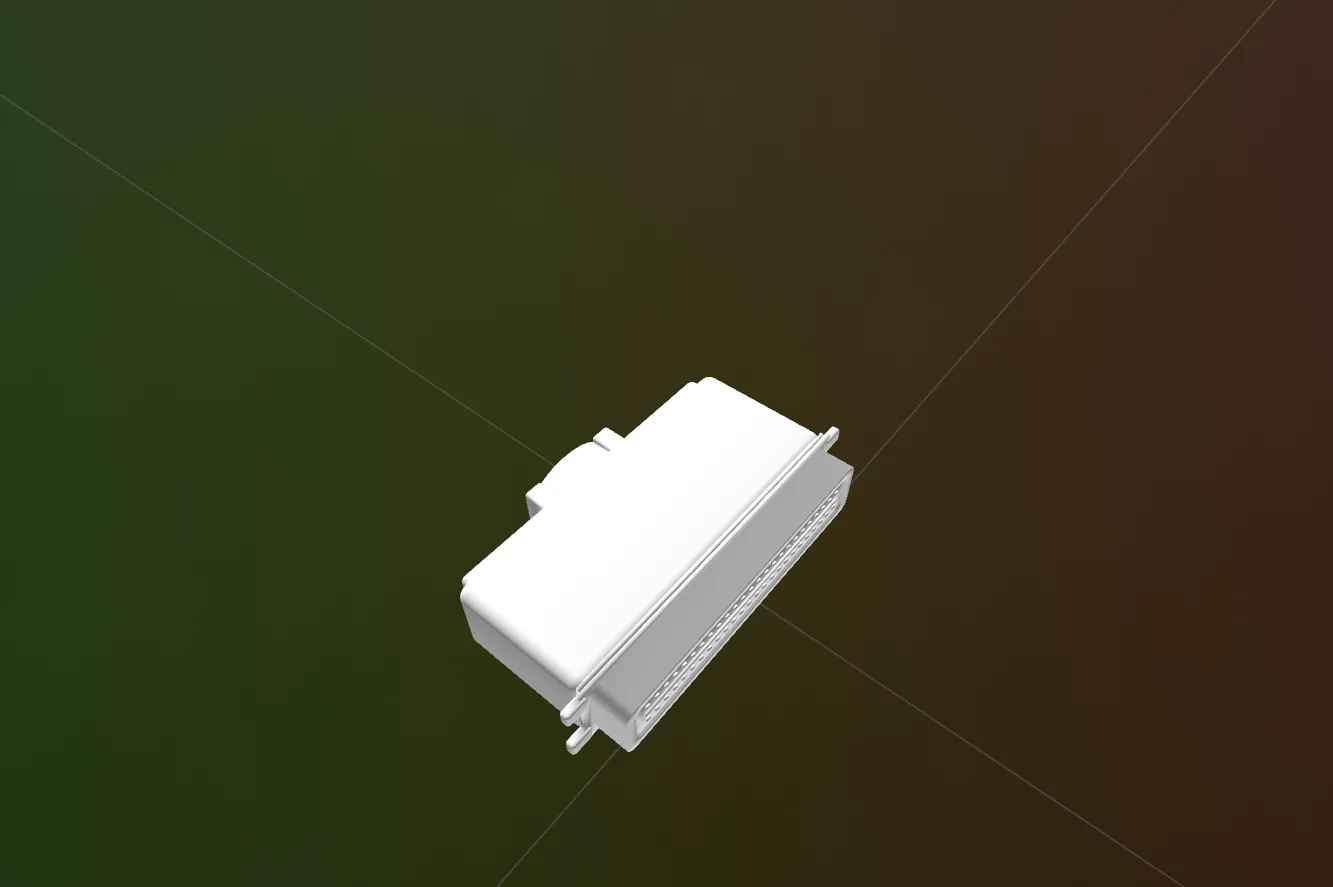
A triangle mesh, expressed in metres, representing the object to grasp.
Result
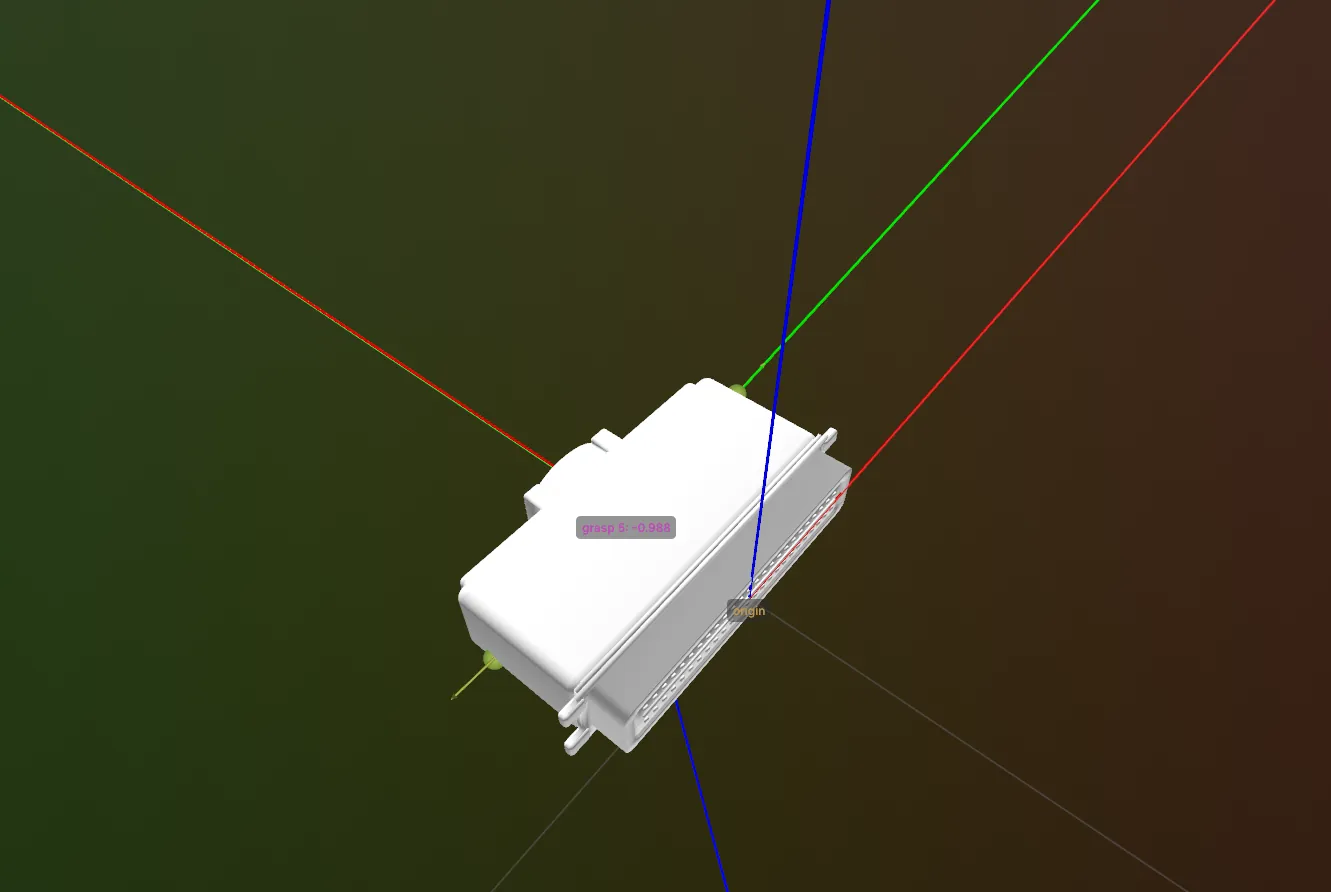
Valid parallel-jaw grasp poses with their paired surface contacts and normals.
The Code
import numpy as np

from telekinesis import datatypes, vitreous

# Load the object mesh. Mesh dimensions must be in metres.
mesh = datatypes.Mesh3D.from_url(
    url="https://assets.telekinesis.ai/examples/v1/meshes/male_pin_connector.obj",
    use_cache=True,
)

# Place the object's coordinate frame at the world origin.
X_WO = np.eye(4, dtype=np.float32)

# Run the skill.
grasps, scores, antipodal_candidates = (
    vitreous.generate_grasps_using_antipodal_sampler(
        mesh=mesh,
        num_grasps=20,
        X_WO=X_WO,
        antipodal_thresh=-0.95,
        max_pt_dist=0.08,
        min_pt_dist=0.005,
        max_sample_retries=500,
        seed=42,
    )
)

# The three outputs are index-aligned.
if len(grasps.data):
    best_pose = grasps.data[0]
    best_score = scores.data[0]
    contact_points = antipodal_candidates.data[0, :2]
    contact_normals = antipodal_candidates.data[0, 2:]
Runnable examples are available in the Telekinesis examples repository.
Follow the README in that repository to set up the environment, then run this example with:
cd telekinesis-examples
python examples/point_cloud/generate_grasps_using_antipodal_sampler.py
Parameter Configuration
| Parameter | Type | Default | Description |
|---|---|---|---|
mesh | datatypes.Mesh3D | np.ndarray | list | required | Triangle mesh of the object, with dimensions in metres. |
num_grasps | datatypes.Int | int | required | Number of unique valid grasp poses to request. Must be non-negative; the sampler can return fewer if it exhausts its retry budget. |
X_WO | datatypes.Transform3D | np.ndarray | list | required | Invertible 4 x 4 pose of the object frame O in the world frame W. Returned grasps are expressed in this world frame. |
antipodal_thresh | datatypes.Float | float | -0.95 | Maximum accepted dot product between the two contact normals, in [-1, 1]. More negative values require more directly opposing normals. |
max_pt_dist | datatypes.Float | float | 0.04 | Maximum permitted distance between contacts, in metres. Must be positive and greater than min_pt_dist; normally set this to the gripper's maximum usable opening. |
min_pt_dist | datatypes.Float | float | 0.005 | Minimum permitted distance between contacts, in metres. Must be non-negative and less than max_pt_dist. |
max_sample_retries | datatypes.Int | int | 100 | Maximum number of rejected ray, contact, or near-duplicate sampling attempts before returning the valid grasps found so far. Must be non-negative. |
seed | datatypes.Int | int | None | 42 | Random seed for reproducible sampling. Use None for nondeterministic sampling. |
Returns
| Type | Description |
|---|---|
datatypes.Transforms3D | grasps: K world-frame TCP poses with shape (K, 4, 4), where K can be smaller than num_grasps. Each origin is the contact midpoint; +Z points from the gripper toward the object, and +Y is the finger-closing axis. Access the matrices through .data. |
datatypes.Array | scores: K contact-normal dot products with shape (K,). More negative scores indicate more antipodal contacts. Access them through .data. |
datatypes.Array | antipodal_candidates: contact data with shape (K, 4, 3), index-aligned with grasps and scores. Each item contains point_1, point_2, normal_1, and normal_2, in that order. |
Raises
| Exception | Condition |
|---|---|
TypeError | A parameter cannot be converted to its expected datatype. |
ValueError | A count is negative, antipodal_thresh is outside [-1, 1], a distance is invalid, min_pt_dist >= max_pt_dist, or X_WO is not invertible. |
ConfigurationError | The TELEKINESIS_API_KEY environment variable is not set. |
SerializationError | The request input or response cannot be serialized or deserialized. |
RequestTimeoutError | The request to the Vitreous service times out. |
TransportError | A network failure occurs before a response is received. |
ClientError | The Vitreous service rejects invalid or malformed input or returns another unexpected 4xx response. |
AuthenticationError | The API key is invalid or expired. |
AuthenticationServiceError | The authentication service is unavailable, times out, or returns an invalid response. |
ServerError | The Vitreous service returns a 5xx or another unexpected response. |
How to Tune the Parameters
num_graspscontrols the target number of unique candidates. Request more when a downstream collision checker or motion planner needs alternatives, but expect longer sampling time.antipodal_threshcontrols contact quality. Values near-1accept only nearly opposite normals; raising it toward0accepts more candidates but permits less stable pinches.min_pt_distandmax_pt_distdefine the usable finger-opening interval. Set them from the gripper's minimum and maximum reliable grasp widths, with clearance for the fingertips and object geometry.max_sample_retriescontrols how long the sampler searches after rejected or duplicate candidates. Increase it for small contact regions or strict thresholds. Exhausting the budget is not an error: the skill returns the valid grasps found so far.X_WOtransforms object-frame grasp geometry into the world frame. Use the object's current estimated pose, or the identity transform when the mesh frame is already the desired planning frame.seedmakes sampling repeatable. Keep a fixed seed for testing and comparisons; useNonewhen varied candidates across calls are useful.
TIP
Best practice: Match the contact-distance limits to the physical gripper, keep a fixed seed while tuning, and always collision-check the returned poses against the gripper and scene before execution.
Where to Use the Skill
Common pipelines include:
- CAD-based bin picking — Generate candidate parallel-jaw grasps from a known object mesh, then rank them using reachability and collision checks.
- Offline grasp library generation — Precompute repeatable grasp poses for known parts and store the candidates with their scores.
- Pose-aware pick planning — Supply an estimated
X_WOto obtain grasp poses directly in the robot's world frame.
Alternative Skills
| Skill | Comparison with Generate Grasps Using Antipodal Sampler |
|---|---|
generate_grasps_using_graspgenx | Uses a learned cross-embodiment model on a segmented object point cloud and explicit gripper geometry. Use it for more general 6-DOF scene-aware proposals; use the antipodal sampler for fast, interpretable, reproducible parallel-jaw candidates from a clean mesh. |
| Calculate Oriented Bounding Box | Provides a simple object center, extent, and orientation but does not test opposing surface contacts. Use it only when a coarse geometry-based pick pose is sufficient. |
When Not to Use the Skill
Do not use Generate Grasps Using Antipodal Sampler when:
- Only a partial or noisy point cloud is available — Use
generate_grasps_using_graspgenxwith a segmented object point cloud and gripper geometry instead. - The end effector is not a parallel-jaw gripper — The returned
+Yclosing axis and contact-pair assumptions do not model suction, multi-finger, or magnetic grasping. - Scene collision avoidance is required from this call alone — The sampler evaluates object-surface contacts, not the full robot or surrounding scene; run collision and reachability checks before execution.
- The mesh scale or object pose is unknown — Correct metre-scale geometry and a valid
X_WOare necessary for physically meaningful grasp widths and world-frame poses.