

Split Image Into Channels
SUMMARY
Split Image Into Channels splits a multi-channel image into its individual channels.
Given an (H, W, C) image, it returns one single-channel (H, W) image per input channel, in the same order as the input (e.g. R, G, B for an RGB image; B, G, R for BGR; R, G, B, A for RGBA). A grayscale (H, W) input is first converted to BGR, so the result is 3 identical channels rather than an error. It is the inverse of merge_image_from_channels — use the two together to process a single channel in isolation and recombine.
Use this Skill when you want to isolate and process a single color channel.
The Skill
from telekinesis import pupil

image_channels = pupil.split_image_into_channels(image=image)
channel_images = image_channels.to_list()Example
Input Image
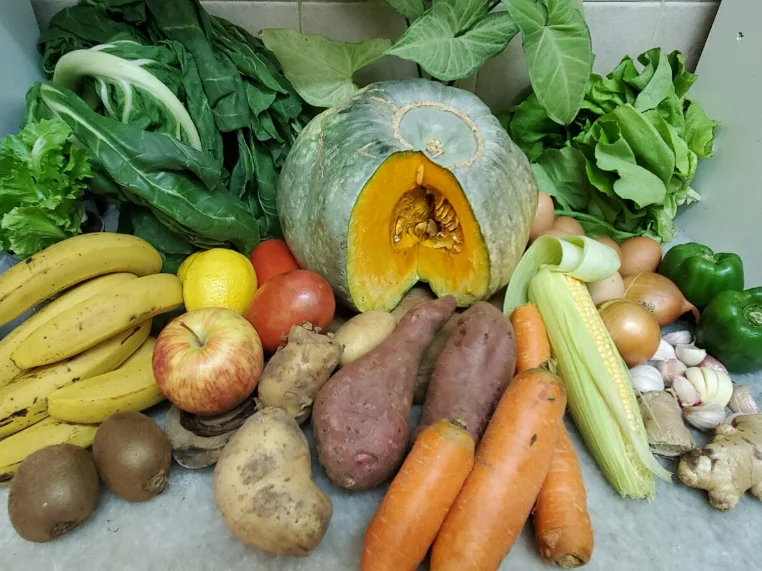
Original multi-channel image
Channel 1 (Red)
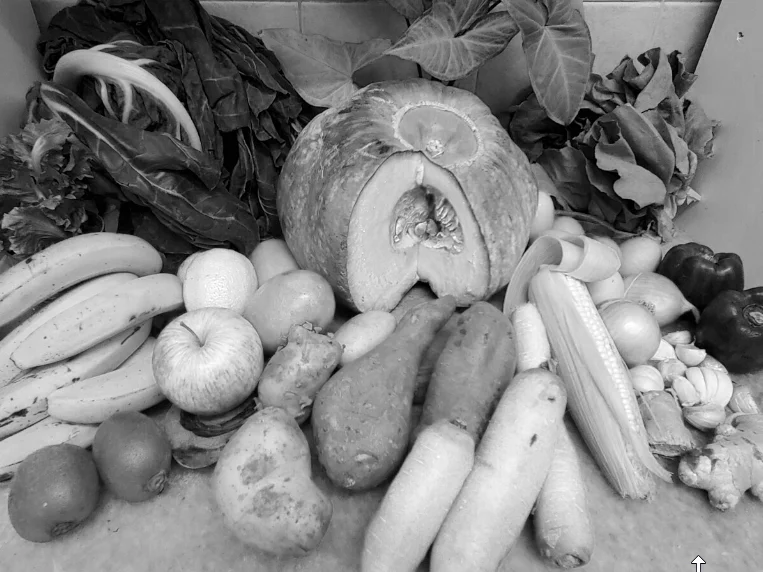
First channel
Channel 2 (Green)
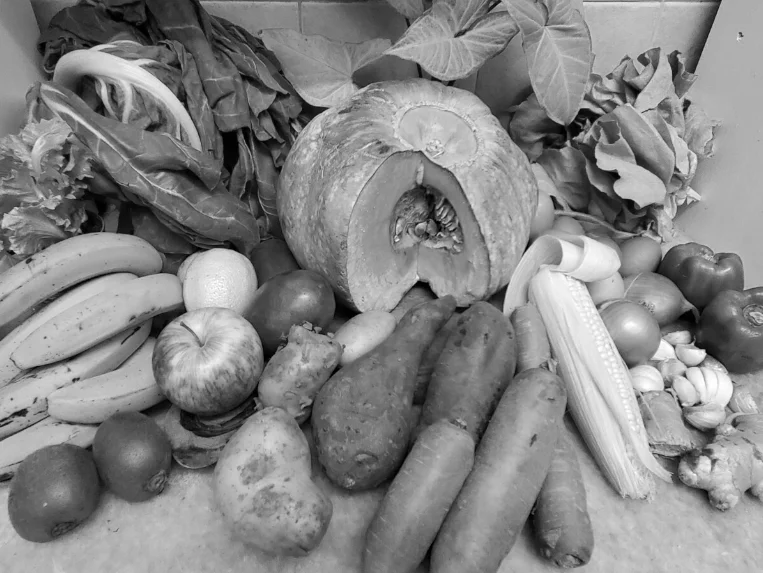
Second channel
Channel 3 (Blue)
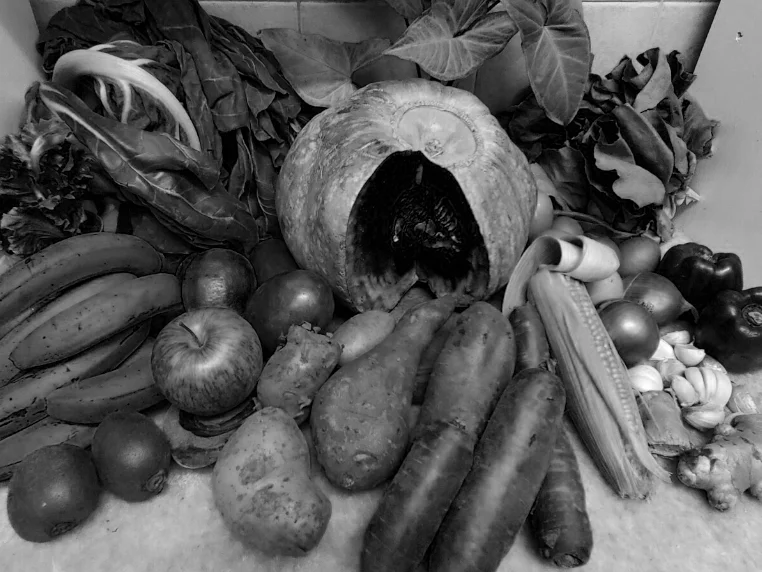
Third channel
The Code
"""Demonstrates splitting an image into color channels."""

from loguru import logger
import rerun as rr

from telekinesis import pupil, datatypes


def split_image_into_channels_example():
    """Splits an image into its color channels."""
    # ===================== Load Image ==========================================
    image_url = "https://assets.telekinesis.ai/examples/v1/images/vegetables.jpg"
    image = datatypes.Image.from_url(image_url)

    # ===================== Run Skill ==========================================
    image_channels = pupil.split_image_into_channels(image=image)

    # ===================== Log ================================================
    logger.success(f"Split {image} into channels")
    logger.success(f"Result: {image_channels}")

    # ===================== Visualization  (Optional) ======================
    rr.init("split_image_into_channels_example", spawn=True)
    datatypes.visualize(image, entity_path="1-Original")
    channel_names = ["Red", "Green", "Blue"]
    for i, channel_image in enumerate(image_channels):
        datatypes.visualize(channel_image, entity_path=f"{i + 2}-{channel_names[i]}")

if __name__ == "__main__":
    split_image_into_channels_example()
Runnable examples are available in the Telekinesis examples repository.
Follow the README in that repository to set up the environment, run this specific example with:
cd telekinesis-examples
python examples/image_processing/split_image_into_channels.py
Parameter Configuration
| Parameter | Type | Default | Description |
|---|---|---|---|
image | datatypes.Image | np.ndarray | required | The input image to split, shape (H, W, C). A grayscale (H, W) image is converted to BGR first, producing 3 identical channels |
Returns
| Type | Description |
|---|---|
datatypes.ImageBatch | One single-channel datatypes.Image per input channel, in input-channel order. Call .to_list() for a plain list[datatypes.Image], or index/iterate the batch directly |
Raises
| Exception | Condition |
|---|---|
TypeError | image has an invalid type |
ConfigurationError | The TELEKINESIS_API_KEY environment variable is not set |
SerializationError | The request input failed to serialize, the response was not returned as an Arrow stream, or the response failed to deserialize |
RequestTimeoutError | The request to the Pupil service timed out |
TransportError | A network failure occurred before a response was received |
ClientError | The Pupil service rejected the request due to invalid or malformed input (HTTP 400/422), an unrecognized endpoint (HTTP 404), or another unexpected 4xx response |
AuthenticationError | The API key was rejected as invalid or expired (HTTP 401) |
AuthenticationServiceError | The authentication service returned an invalid response, was temporarily unavailable, or timed out (HTTP 502/503/504) |
ServerError | The Pupil service returned a 5xx or otherwise unexpected error response |
How to Tune the Parameters
The split_image_into_channels Skill takes a single input and has no tunable behavior — the number and order of output channels is fully determined by the input image.
image
- Controls: Which image is split, and therefore how many channels come out (3 for RGB/BGR, 4 for RGBA, 3 identical channels for a grayscale input) and in what order.
- Default: required, no default
- No numeric tuning is available; the output order always mirrors the input's channel order.
TIP
Best practice: Know your input's channel order before indexing the result — index 0 is R for an RGB image but B for a BGR image. Convert with convert_image_color_space first if you need a specific, known order.
Where to Use the Skill
Common pipelines include:
- Per-channel processing – Apply a filter or enhancement to a single channel (e.g. blur only the blue channel) before recombining with
merge_image_from_channels - Channel-based analysis – Inspect or threshold one channel's intensity distribution independently
- Channel swapping – Reorder channels (e.g. RGB to BGR) by splitting and merging in a different order
Alternative Skills
| Skill | vs. Split Image Into Channels |
|---|---|
| merge_image_from_channels | The inverse operation — recombines single-channel images into one multi-channel image. Use it after processing the channels this Skill produces. |
| convert_image_color_space | Converts the whole image to a different color space in one call. Use this Skill instead only when you need per-channel access rather than a full conversion. |
When Not to Use the Skill
Do not use Split Image Into Channels when:
- You only need a single channel, not all of them (index the array directly, or convert to grayscale with
convert_image_color_space) - The image is already single-channel (grayscale) (splitting just duplicates it three times — a no-op you can skip)
- You need channels of a different color space (e.g. HSV, LAB) (convert with
convert_image_color_spacefirst, then split)