

Filter Image Using Laplacian
SUMMARY
Filter Image Using Laplacian detects edges by computing the second spatial derivative of an image.
It locates regions where intensity changes rapidly by responding to zero-crossings/sign-changes of the second derivative, which makes it isotropic (direction-independent) — unlike the directional, first-derivative filter_image_using_sobel. It is also more sensitive to noise than a first-derivative filter; pre-smooth with filter_image_using_gaussian_blur first if the input is noisy. output_format controls whether negative edge responses are preserved (signed/float formats) or clipped (unsigned formats).
Use this Skill when you want to detect edges in all directions using second-order derivatives.
The Skill
from telekinesis import pupil

filtered_image = pupil.filter_image_using_laplacian(
    image=image,
    output_format="32bit",
    kernel_size=5,
    scale=1.0,
    delta=0.0,
    border_type="default",
)Example
Input Image
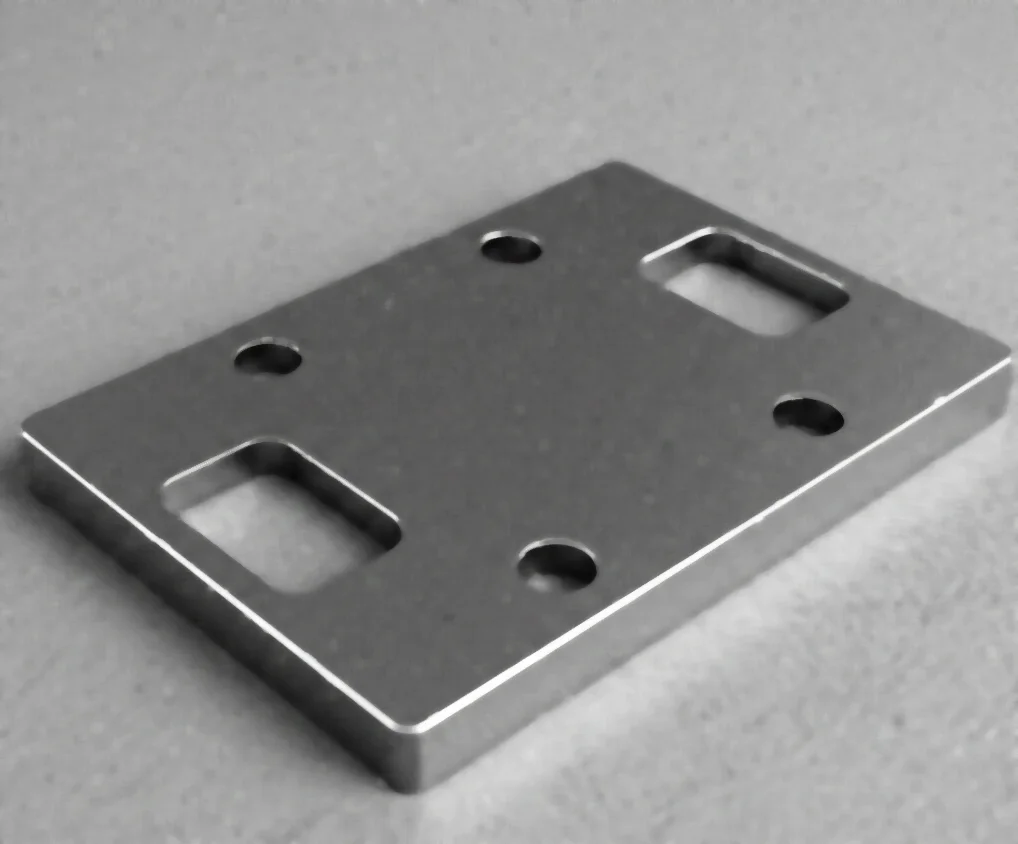
Original grayscale image
Filtered Image
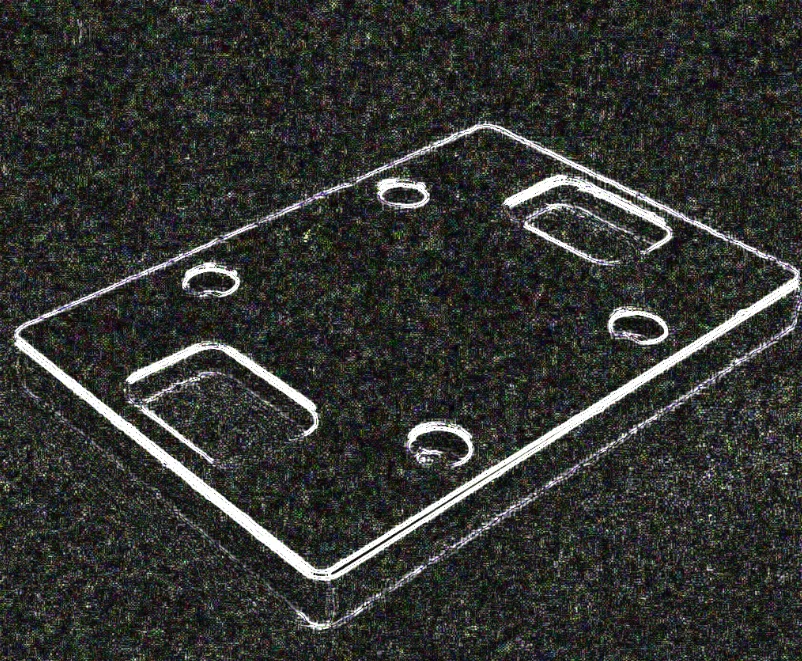
Edge response with kernel_size=5, output_format="32bit" - highlights edges and fine details
The Code
"""Demonstrates filter_image_using_laplacian operation."""

from loguru import logger
import rerun as rr

from telekinesis import pupil, datatypes


def filter_image_using_laplacian_example():
    """Applies filter_image_using_laplacian operation."""
    # ===================== Load Image ==========================================
    image_url = "https://assets.telekinesis.ai/examples/v1/images/flat_mechanical_component_denoised.png"
    image = datatypes.Image.from_url(image_url)

    # ===================== Run Skill ==========================================
    filtered_image = pupil.filter_image_using_laplacian(
        image=image,
        output_format="32bit",
        kernel_size=5,
        scale=1.0,
        delta=0.0,
        border_type="default",
    )

    # ===================== Log ================================================
    logger.success(f"Applied filter_image_using_laplacian on {image}")
    logger.success(f"Result: {filtered_image}")

    # ===================== Visualization  (Optional) ======================
    rr.init("filter_image_using_laplacian_example", spawn=True)
    datatypes.visualize(image, entity_path="1-Original")
    datatypes.visualize(filtered_image, entity_path="2-Filtered")

if __name__ == "__main__":
    filter_image_using_laplacian_example()
Runnable examples are available in the Telekinesis examples repository.
Follow the README in that repository to set up the environment, run this specific example with:
cd telekinesis-examples
python examples/image_processing/filter_image_using_laplacian.py
Parameter Configuration
| Parameter | Type | Default | Description |
|---|---|---|---|
image | datatypes.Image | np.ndarray | required | The input image to filter. Recommended to be grayscale, shape (H, W) |
kernel_size | datatypes.Int | int | 1 | Size of the Laplacian kernel. Must be a positive odd integer (typically 1, 3, 5, or 7) |
output_format | datatypes.String | str | "same as input" | Output bit depth: "same as input", "8bit", "16bitS", "16bitU", "32bit", "64bit". Signed/float formats preserve negative edge responses; "8bit"/"16bitU" clip them |
scale | datatypes.Float | float | int | 1.0 | Scale factor applied to the computed Laplacian values |
delta | datatypes.Float | float | int | 0.0 | Offset added to the output, useful for visualization |
border_type | datatypes.String | str | "default" | Border handling mode: "default", "constant", "replicate", "reflect", "reflect 101" |
Returns
| Type | Description |
|---|---|
datatypes.Image | The second-derivative edge response, same shape as the input, in the dtype specified by output_format |
Raises
| Exception | Condition |
|---|---|
TypeError | A parameter's value does not match its expected type (see the Parameter Configuration table above) |
ValueError | kernel_size is not a positive odd integer, or output_format/border_type is not one of the supported options |
ConfigurationError | The TELEKINESIS_API_KEY environment variable is not set |
SerializationError | The request input failed to serialize, the response was not returned as an Arrow stream, or the response failed to deserialize |
RequestTimeoutError | The request to the Pupil service timed out |
TransportError | A network failure occurred before a response was received |
ClientError | The Pupil service rejected the request due to invalid or malformed input (HTTP 400/422), an unrecognized endpoint (HTTP 404), or another unexpected 4xx response |
AuthenticationError | The API key was rejected as invalid or expired (HTTP 401) |
AuthenticationServiceError | The authentication service returned an invalid response, was temporarily unavailable, or timed out (HTTP 502/503/504) |
ServerError | The Pupil service returned a 5xx or otherwise unexpected error response |
How to Tune the Parameters
The filter_image_using_laplacian Skill exposes five parameters that control the scale of edges detected, their amplification, and how the response is represented.
kernel_size
- Controls: The spatial scale of the second-derivative approximation.
- Units: Pixels
- Default:
1 - Increase → detects larger-scale edges, more compute
- Decrease → finer edge detail, more noise-sensitive
- Typical range: 1, 3, 5, 7. Use 1 or 3 for fine details, 5 or 7 for larger edges
output_format
- Controls: The numerical bit depth/precision of the returned edge response.
- Default:
"same as input" - Options:
same as input– keeps the input dtype; may clip negative responses8bit– unsigned 8-bit; clips negative values, prefer a signed/float format if negative responses matter16bitS– signed 16-bit; preserves negative responses16bitU– unsigned 16-bit32bit/64bit– float; preserves negative responses and precision
scale
- Controls: A multiplier applied to the raw Laplacian values.
- Default:
1.0 - Increase → amplifies edge responses
- Decrease → more subtle edge responses
- Typical range: 0.1-10.0. Use 0.1-1.0 for subtle edges, 1.0-5.0 for normal, 5.0-10.0 for strong emphasis
delta
- Controls: A constant offset added to every output pixel.
- Default:
0.0 - Typical range: -128.0 to 128.0. Use
0.0for numerical processing; a positive offset (e.g.128.0) shifts negative values into a visible range for 8-bit visualization
border_type
- Controls: How pixels beyond the image boundary are synthesized when the kernel extends past the edge.
- Default:
"default" - Options:
default– library default (same asreflect 101)constant– pads with a fixed valuereplicate– repeats the edge pixelreflect– mirrors without repeating the edge pixelreflect 101– mirrors with the edge pixel repeated, avoiding dark borders
TIP
Best practice: Use a signed or float output_format ("16bitS", "32bit", "64bit") for downstream numerical processing so negative edge responses aren't lost; only add a delta offset and switch to an unsigned format for direct 8-bit visualization.
Where to Use the Skill
Common pipelines include:
- Edge detection for shape analysis – Find object boundaries with omnidirectional sensitivity
- Image sharpening – Subtract the Laplacian response from the original image to enhance detail
- Zero-crossing / blob detection – Locate edges or blobs at sign changes of the second derivative
- Focus/sharpness assessment – Use response magnitude as a proxy for image sharpness
Alternative Skills
| Skill | vs. Filter Image Using Laplacian |
|---|---|
| filter_image_using_sobel | Computes a directional first-order gradient instead of an isotropic second-order response; use Sobel when edge orientation matters. |
| filter_image_using_scharr | A first-derivative gradient filter with better rotation invariance than Sobel; still directional, unlike Laplacian. |
| filter_image_using_gaussian_blur | Common pre-processing step to reduce noise before applying the Laplacian. |
When Not to Use the Skill
Do not use Filter Image Using Laplacian when:
- The input hasn't been denoised (the second derivative amplifies noise heavily; pre-smooth with
filter_image_using_gaussian_blurfirst) - You need edge orientation/direction (use
filter_image_using_sobelorfilter_image_using_scharrinstead) - You need thick, connected edge contours rather than a raw per-pixel response (post-process with thresholding or morphological operations)
- You need the most accurate gradient magnitude (use a first-derivative filter such as Sobel or Scharr)