
Capture Point Cloud
SUMMARY
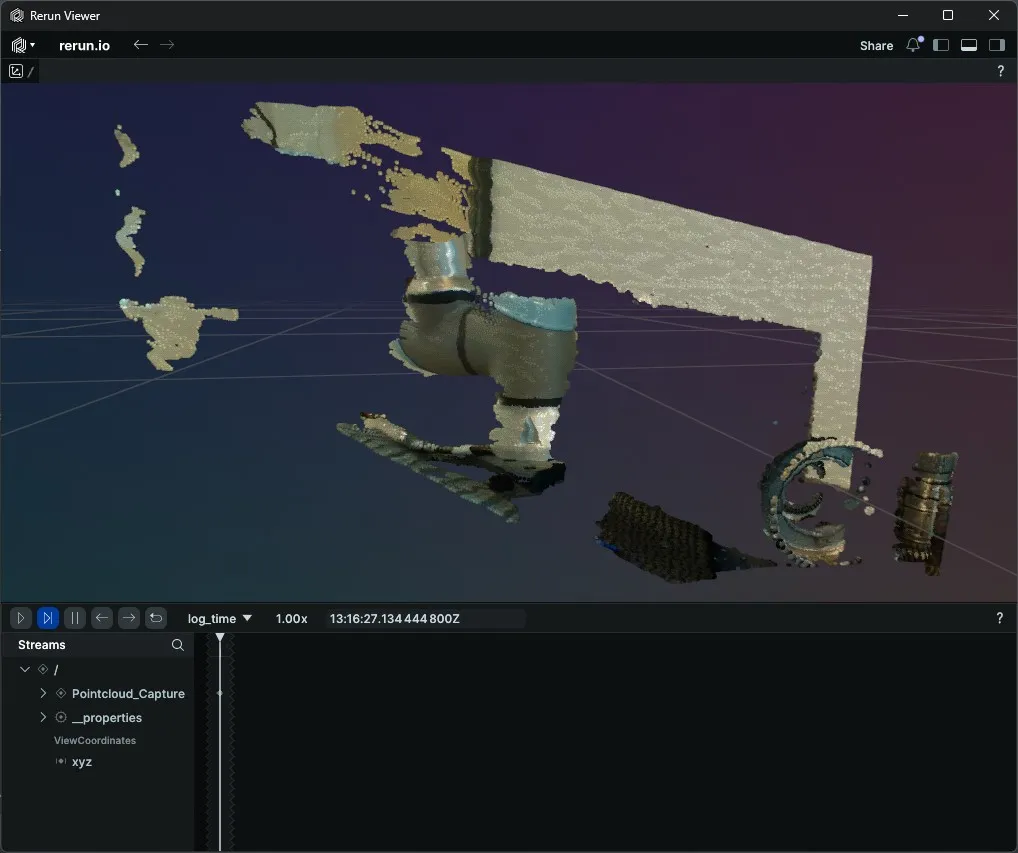
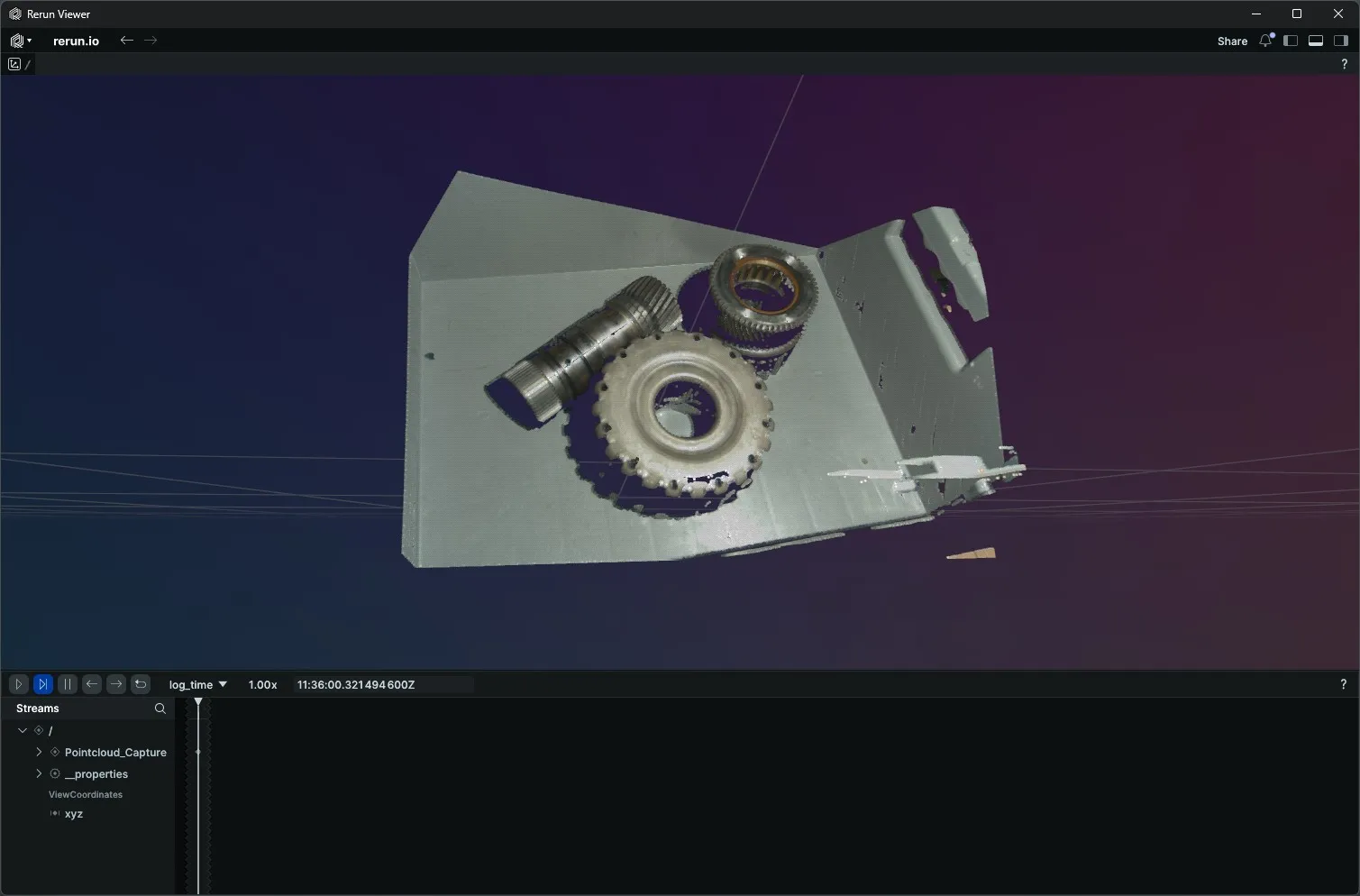
Capture Point Cloud produces a colour-mapped 3D point cloud. The returned object has .positions (Nx3 float XYZ) and .colors (Nx3 uint8 RGB) arrays ready to log with rr.Points3D.
Available on: Intel RealSense, Zivid.
The Skill
point_cloud = camera.capture_pointcloud()Example
Intel RealSense
Zivid
The Code
"""
Capture a colour-mapped point cloud from a RealSense camera and
visualise it in Rerun.

Run from a terminal to avoid issues with Rerun's spawn mode.
"""
from loguru import logger

import rerun as rr

from telekinesis.medulla.cameras import realsense

def main():
    camera = realsense.RealSense(name="my_realsense_camera")
    try:
        rr.init("RealSense_Pointcloud_Example", spawn=True)
        rr.log("/", rr.ViewCoordinates.RDF, static=True)
        camera.connect()

        point_cloud = camera.capture_pointcloud()
        if point_cloud is None:
            logger.error("Failed to capture point cloud.")
            return
        rr.log(
            "Pointcloud_Capture",
            rr.Points3D(
                positions=point_cloud.positions,
                colors=point_cloud.colors
            )
        )
    except Exception as e:
        logger.error(
            f"Unable to capture point cloud. Caught exception: {type(e).__name__}: {e}"
        )
    finally:
        rr.disconnect()
        camera.disconnect()

if __name__ == "__main__":
main()"""
Capture a colour-mapped point cloud from a Zivid camera and
visualise it in Rerun.
Run from a terminal to avoid issues with Rerun's spawn mode.
"""
from loguru import logger
import rerun as rr
from telekinesis.medulla.cameras import zivid
def main():
camera = zivid.Zivid(name="my_zivid_camera")
try:
rr.init("Zivid_Pointcloud_Example", spawn=True)
rr.log("/", rr.ViewCoordinates.RDF, static=True)
camera.connect()
point_cloud = camera.capture_pointcloud()
if point_cloud is None:
logger.error("Failed to capture point cloud.")
return
rr.log(
"Pointcloud_Capture",
rr.Points3D(
positions=point_cloud.positions,
colors=point_cloud.colors
)
)
except Exception as e:
logger.error(
f"Unable to capture point cloud. Caught exception: {type(e).__name__}: {e}"
)
finally:
rr.disconnect()
camera.disconnect()
if __name__ == "__main__":
main()The Explanation of the Code
Before connecting, the Rerun viewer is opened and a world coordinate frame is set. rr.ViewCoordinates.RDF declares Right-Down-Forward axes, matching the depth sensor's native orientation so the 3D scene renders the right way up. Passing static=True logs this once and never repeats it on subsequent frames.
rr.init("RealSense_Pointcloud_Example", spawn=True)
rr.log("Captured_Pointcloud", rr.ViewCoordinates.RDF, static=True)
After connect has initialised the camera, capture_pointcloud fuses depth and colour data to produce a point cloud object. Its .positions attribute is an Nx3 float array of XYZ coordinates in metres and its .colors attribute is an Nx3 uint8 array of per-point RGB values. The explicit None check handles the rare case where the capture fails to produce a valid frame.
point_cloud = camera.capture_pointcloud()
if point_cloud is None:
    logger.error("Failed to capture point cloud.")
    return
Per-camera behavior:
- RealSense — captures one depth frame and one colour frame via librealsense, aligns them, and builds the point cloud.
- Zivid — performs a combined 2D+3D capture, extracts the XYZRGBA structured array from the Zivid SDK, filters out NaN points, and converts XYZ from millimetres to metres. Settings should be loaded beforehand with
load_settings.
rr.Points3D logs the full coloured cloud to Rerun in a single call. No JPEG encoding is needed — positions and colours are passed as numeric arrays directly.
rr.log(
    "Pointcloud_Capture",
    rr.Points3D(positions=point_cloud.positions, colors=point_cloud.colors),
)
The disconnect call lives in a finally block so the camera resources are released regardless of whether the capture succeeded.
Running the Example
Change to the respective camera examples folder in telekinesis-examples and run
python capture_pointcloud.pyA Rerun viewer opens automatically. The colour-mapped point cloud appears under Pointcloud_Capture once acquisition completes.
Where to Use the Skill
- Bin picking and grasp planning — feed the point cloud into pose-estimation pipelines.
- Static scene reconstruction — capture a one-shot 3D snapshot before motion planning.
- Sensor diagnostics — verify depth-colour alignment without running a continuous stream.